The Confidence Interval
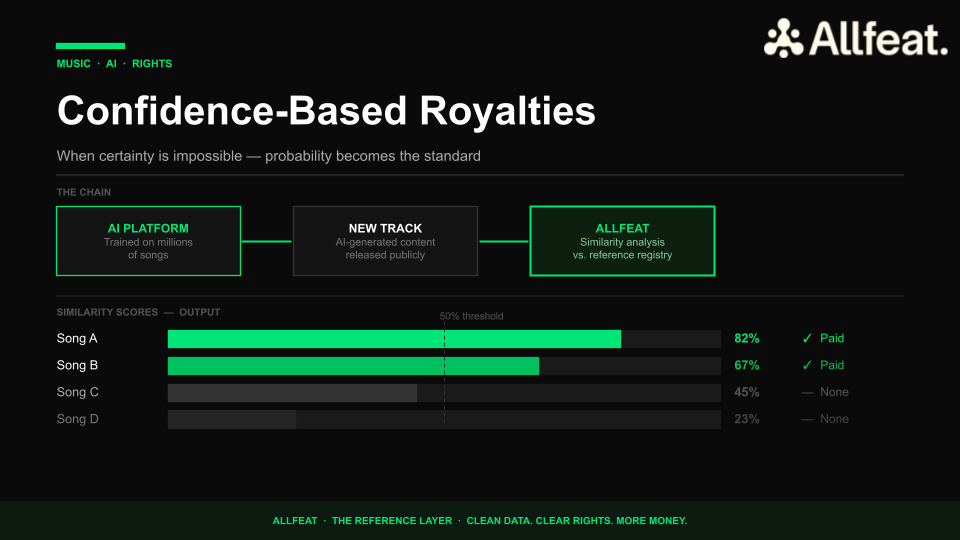
the future of music royalties in the age of #AI
The music industry is hitting a wall. With generative AI, millions of works are potentially being used to train models or generate derivative content. The problem ? Proving with absolute certainty that a specific work was used is nearly impossible. So the industry will have to accept an uncomfortable truth: 100% proof may never exist.
But that doesn't mean artists can't be paid. Here is my conviction: confidence interval-based royalties are the economic model of the AI era.
The principle is simple. Rather than a binary system (used / not used) we analyze the similarity between AI-generated content and existing works. We get a score :
"There is a 78% chance this AI used this song."
Above a threshold collectively defined by the industry, the rights holder is compensated proportionally. This is not a revolutionary idea in itself. Sacem, ASCAP, Broadcast Music, Inc. (BMI), and SUISA or GEMA already distribute royalties on a statistical basis.
Insurance companies have been monetizing probabilistic risk for centuries.
We are simply applying that same logic to a new problem. But for this system to work, one condition is absolute: clean, reliable, and universal music data.
Without a precise acoustic fingerprint for every work, the similarity score is worthless (legally and commercially).
That is exactly what Allfeat Foundation is laucnhing.
A reference registry.
A unique fingerprint per work.
The source of truth without which no confidence interval can be calculated, defended, or accepted.
The industry took decades to structure its response to sampling. It does not have decades to respond to AI.
The foundation exists.
It's called Allfeat Foundation.